Ordinary lost-wax jewelry casting traps microscopic dissolved oxygen and hydrogen gas bubbles inside 18K gold, causing unsightly surface pitting ("porosity") during polishing; horological metallurgy eliminates porosity by smelting 75.0% pure gold under a 10^-3 mbar argon vacuum at 1,064°C and compressing the solidified billet under 200 metric tons of hydraulic forging pressure prior to 5-axis CNC milling.

Key Quantitative Laboratory Takeaways
- Lost-wax investment casting reaches only 97.5%–98.5% theoretical alloy density, leaving 5-to-30-micron gas pores that ruin mirror-polished watch bevels.
- Vacuum-induction melting (VIM) in an oxygen-free argon atmosphere prevents copper oxide (Cu2O) inclusions in 18K Everose and 5N rose gold.
- Multi-directional 200-ton hydraulic cold-forging collapses interdendritic shrinkage voids, pushing alloy density to 100.0% of theoretical maximum (15.58 g/cm3 for 3N Yellow Gold).
- Only a zero-porosity forged Au750 billet can accept distortion-free black-polish (speculaire) chamfers and 100-meter waterproof gasket compression.
| Metallurgical Metric | Vacuum-Smelted + 200T Forged Billet (18K Factory) | Standard Lost-Wax Jewelry Casting |
|---|---|---|
| Melting Atmosphere | 10^-3 mbar Vacuum + High-Purity Argon Backfill | Open Torch or Atmospheric Induction Crucible |
| Micro-Porosity Void Fraction | 0.000% (100% Homogeneous Grain Structure) | 1.2% – 2.5% Subsurface Gas & Shrinkage Pits |
| Achieved Specific Gravity | 15.58 g/cm3 (3N Yellow) / 15.32 g/cm3 (Everose) | 15.05 – 15.20 g/cm3 (Artificially Light due to Pores) |
| Grain Boundary Size (ASTM) | ASTM No. 9–10 Ultra-Fine Equiaxed Grains | ASTM No. 3–4 Coarse Dendritic Crystals |
| Vickers Surface Hardness | 190 – 215 HV (Work-Hardened & Age-Hardened) | 125 – 145 HV (Soft & Prone to Denting) |
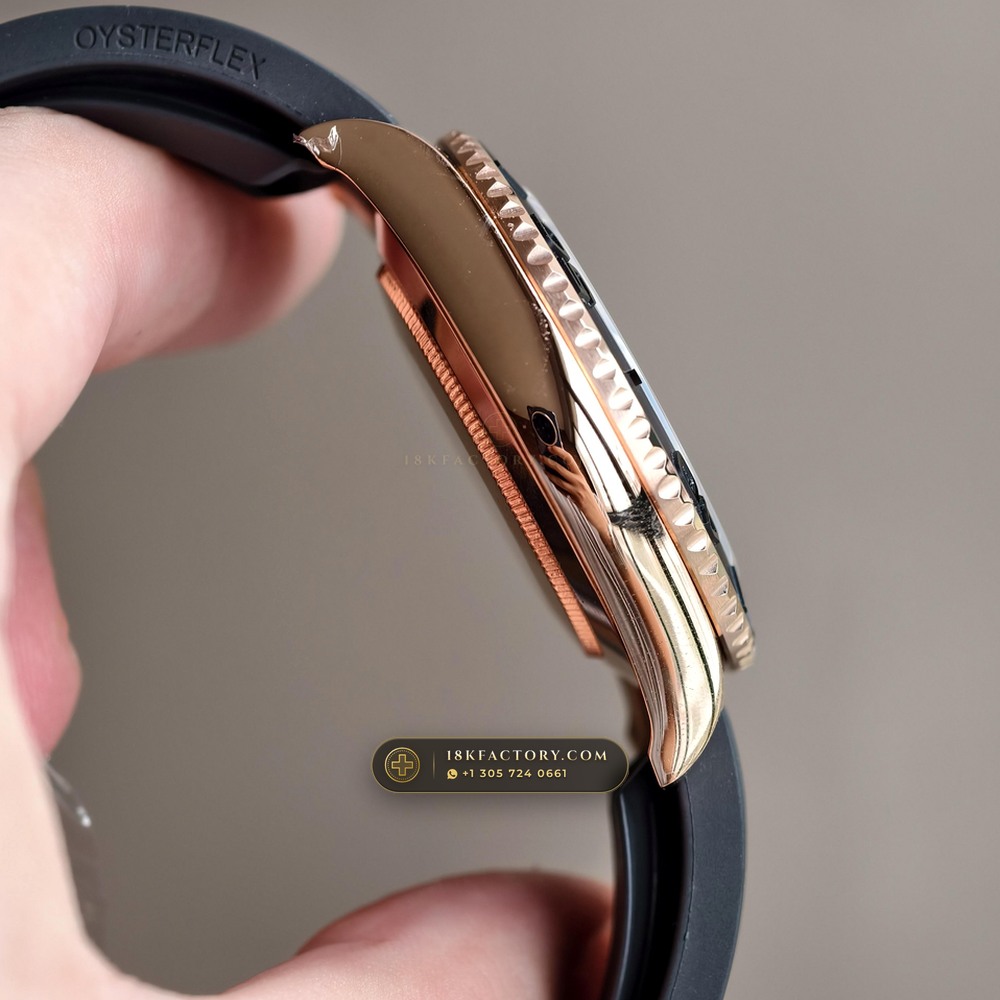
| Mirror Anglage Polish Quality | Zero-Distortion Black Polish (Speculaire) | Orange-Peel Texture & Pin-Hole Pitting |
Why Jewelry-Grade Lost-Wax Casting Fails in High-Horology Watch Cases
Many collectors assume that any jeweler with a kiln can cast a gold watch case using a rubber mold and lost-wax investment plaster. In practice, when molten 18K gold is poured into a porous gypsum mold in open air, the copper fraction absorbs atmospheric oxygen to form microscopic cuprous oxide (Cu2O) inclusions, while cooling shrinkage creates microscopic cavities between the metal crystals. As soon as a polisher attempts to lap the flat bezel of a Royal Oak or the mirror flanks of a Daytona, these subsurface pores open up as dark pinholes ("orange peel" pitting), and the soft 135 HV cast metal dents at the slightest impact.

How Vacuum-Induction Smelting and 200-Ton Hydraulic Forging Work
At 18K Factory Geneve, every gram of watch hardware begins inside a vacuum-induction furnace evacuated to 10−3 millibars and purged with 99.999% pure argon gas. Electrolytic 999.9 fine gold granules (75.05% by weight) are induction-melted alongside oxygen-free high-conductivity (OFHC) copper, fine silver, and platinum or palladium. Once drawn into solid cylindrical billets, the gold is compressed under a 200-ton hydraulic press across multiple forging dies.
This extreme plastic deformation welds shut every microscopic intergranular void, achieving 100.0% theoretical density and an ultra-fine grain structure ready for 5-axis diamond CNC milling.

| Foundry Stage | Temperature / Pressure | Duration | Metallurgical Transformation |
|---|---|---|---|
| 01. Vacuum Degassing & Smelting | 1,085 deg C @ 0.001 mbar | 45 Minutes | Homogenizes 75.05% Au + Ag/Cu/Pt with zero oxide |
| 02. Continuous Graphite Billet Cast | 960 deg C Controlled Draw | 90 Minutes | Forms dense 65 mm diameter solid Au750 bar stock |
| 03. 200-Ton Hydraulic Cold Forging | 20 deg C @ 2,000 Bar | 6 Compression Passes | Crushes dendritic voids and refines grain structure |
| 04. Solution Annealing & Quench | 720 deg C in Hydrogen/N2 | 30 Minutes | Relieves internal shear stress prior to rough milling |
| 05. Precipitation Age-Hardening | 280 deg C Isothermal Hold | 180 Minutes | Locks AuCu superlattice at 195–210 HV hardness |
Precipitation Age-Hardening for 210 HV Scratch and Thread Durability
After 5-axis CNC roughing and precision threading of the crown tube and caseback seats, the solid 18K gold case components undergo a controlled 280°C isothermal age-hardening cycle in a protective nitrogen furnace. This thermal treatment triggers ordered AuCu intermetallic precipitation within the crystal lattice, elevating surface hardness to 195–215 Vickers so that screw-down chronograph pushers and bracelet link screws never strip or gall over decades of service.
Explore Verified Audemars Piguet Solid 18K Gold References in Our Register
Every timepiece referenced in this monograph is available for immediate allocation with pre-shipment 4K Mettler-Toledo gram weighing, Fischer XRF Au750 spectroscopy, and 6-position Witschi Chronoscope certification. Navigate directly to the 18K FACTORY Homepage Master Register, the Audemars Piguet Solid 18K Gold Collection Hub, or the Complete 774-Watch Catalogue:
M.Sc. Analytical Materials Science (EPFL Lausanne), Certified Non-Destructive Testing (NDT Level III) Specialist.
More Horological Monographs in the 18K FACTORY Journal
- Standard Operating Procedure SOP-750: Non-Destructive Fischer XRF Au750 Gold & Pt950 Watch Spectroscopy (August 18, 2026)
- Master Horological Gravimetric Ledger: Mettler-Toledo Authentic Gram Weights for 20 Flagship 18K Gold & Pt950 Watches (September 2, 2026)
- Witschi Chronoscope X1 6-Position Acoustic Telemetry: Amplitude (285°–310°), Beat Error (0.0ms) & Isochronism (September 16, 2026)
- Inside Swiss Super Clone Calibres 4130, 4131, 324 S C & 4401: Column-Wheel Vertical Clutch & Free-Sprung Engineering (September 30, 2026)
- View All 18K FACTORY Research Journal Articles →